 Brock Biology of Microorganisms 15th edition (global) – eTextBook
  The Basic Practice of Statistics 8th Edition, ISBN-13: 978-1319042578
  The Cutaneous Lymphoid Proliferations: A Comprehensive Textbook of Lymphocytic Infiltrates of the Skin 2nd Edition, ISBN-13: 978-1118776261
  Principles of Anatomy and Physiology (15th Edition) – eBooks
  Strategic Modelling and Business Dynamics 2nd Edition, ISBN-13: 9781118844687
  Mathematical Modeling of Pharmacokinetic Data – eBook PDF
  International Financial Management (14th Edition) – eBook PDF
  Leadership: Theory and Practice (7th Edition) – eBook
  James Stewart’s Calculus: Early Transcendentals (8th edition) – eTextBook
  Essentials of Cultural Anthropology: A Toolkit for a Global Age (2nd Edition) – eBook
  Comprehensive Clinical Nephrology (6th Edition) – eBook
  Elementary Statistics Using Excel (6th Edition) – eBook
  The Analysis and Design of Linear Circuits (8th Edition) – eBook PDF
  Genetic Association Studies: Background, Conduct, Analysis, Interpretation – eBook PDF
  Biological Psychology (13th Edition) – eBook
  Chemistry and Biochemistry of Food Jose Perez-Castineira, ISBN-13: 978-3110595475
  Adenocarcinoma of the Esophagogastric Junction Simone Giacopuzzi, ISBN-13: 978-3319287744
  Microeconomics 13th Edition Roger A. Arnold, ISBN-13: 978-1337617406
  Strategies & Tactics for the MPRE 7th Edition by Steven L. Emanuel, ISBN-13: 978-1543807721
  Spacetime and Geometry: An Introduction to General Relativity, ISBN-13: 978-1108488396
  Statistics for Business and Economics 8th GLOBAL Edition, ISBN-13: 978-0273767060
  Fundamentals of Information Systems Security (3rd Edition) – eBook
  Handbook of General Hospital Psychiatry – Massachusetts General Hospital (7th Edition) – eBook
  Research Methods for Criminal Justice and Criminology: A Text and Reader – eBook PDF
  Health Policy and Politics: A Nurse’s Guide 6th Edition by Jeri A. Milstead, ISBN-13: 978-1284126372
 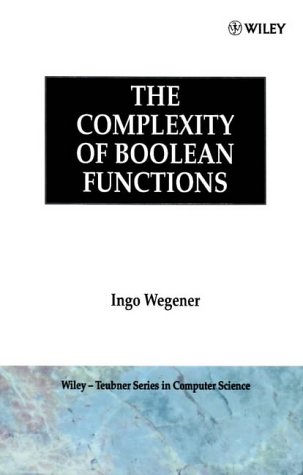 The Complexity of Boolean Functions by Ingo Wegener, ISBN-13: 978-0471915553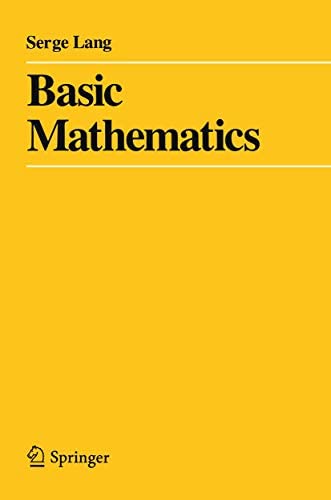
Description
Basic Mathematics by Serge Lang, ISBN-13: 978-0387967875
[PDF eBook eTextbook]
- Publisher: Springer
- Language: English
- 496 pages
- ISBN-10: 0387967877
- ISBN-13: 978-0387967875
This text in basic mathematics is ideal for high school or college students. It provides a firm foundation in basic principles of mathematics and thereby acts as a springboard into calculus, linear algebra and other more advanced topics. The information is clearly presented, and the author develops concepts in such a manner to show how one subject matter can relate and evolve into another.
The present book is intended as a text in basic mathematics. As such, it can have multiple use: for a one-year course in the high schools during the third or fourth year (if possible the third, so that calculus can be taken during the fourth year); for complementary reference in earlier high school grades (elementary algebra and geometry are covered); for a one-semester course at the college level, to review or to get a firm foundation in the basic mathematics to go ahead in calculus, linear algebra, or other topics.
Table of Contents:
PART I
ALGEBRA
Numbers
The integers . . . . 5
Rules for addition . . . . . 8
Rules for multiplication . . . . 14
Even and odd integers; divisibility . 22
Rational numbers . . . . . 26
Multiplicative inverses . . . 42
Linear Equations
Equations in two unknowns . 53
Equations in three unknowns 57
Real Numbers
Addition and multiplication . 61
Real numbers: positivity . 64
Powers and roots . . . . 70
Inequalities . . . 75
Quadratic Equations . 83
On Logic and Mathematical Expressions
On reading books . 93
Logic . . . . 94
Sets and elements . 99
Notation 100
PART II INTUITIVE GEOMETRY
Chapter 5 Distance and Angles
1 Distance 107
2 A n g le s ……………………….. 110
3 The Pythagoras theorem . 120
Chapter 6 Isometries
1 Some standard mappings of the plane . 133
2 Isometries………………………………………. 143
3 Composition of isometries . . . . 150
4 Inverse of isometries……………………….. 155
5 Characterization of isometries 163
6 Congruences . . . . 166
Chapter 7 Area and Applications
1 Area of a disc of radius r . . . . 173
2 Circumference of a circle of radius r 180
PART III COORDINATE GEOMETRY
Chapter 8 Coordinates and Geometry
1 Coordinate systems 191
2 Distance between points . 197
3 Equation of a circle 203
4 Rational points on a circle 206
Chapter 9 Operations on Points
1 Dilations and reflections…………………………………. 213
2 Addition, subtraction, and the parallelogram law . 218
Chapter 10 Segments, Rays, and Lines
1 Segments 229
2 Rays. . . . 231
3 L i n e s ……………………………. 236
4 Ordinary equation for a line . 246
Chapter 11 Trigonometry
1 Radian measure 249
2 Sine and cosine. 252
3 The graphs . 264
4 The tangent 266
CONTENTS
Addition formulas .
Rotations
Some Analytic Geometry
The straight line again
The parabola
The ellipse . . . .
The hyperbola .
Rotation of hyperbolas
MISCELLANEOUS
Functions
Definition of a function
Polynomial functions .
Graphs of functions
Exponential function .
Logarithms
Mappings
Definition . . . .
Formalism of mappings
Permutations
Complex Numbers
The complex plane
Polar form .
Induction and Summations
Induction
Summations
Geometric series
Determinants
M a t r i c e s
Determinants of order 2 .
Properties of 2 X 2 determinants
Determinants of order 3 .
Properties of 3 X 3 determinants
Cramer’s Rule
Index
Serge Lang (May 19, 1927 – September 12, 2005) was a French-American mathematician and activist who taught at Yale University for most of his career. He is known for his work in number theory and for his mathematics textbooks, including the influential Algebra. He received the Frank Nelson Cole Prize in 1960 and was a member of the Bourbaki group.
Lang was born in Saint-Germain-en-Laye, close to Paris, in 1927. He had a twin brother who became a basketball coach and a sister who became an actress. Lang moved with his family to California as a teenager, where he graduated in 1943 from Beverly Hills High School. He subsequently graduated with an AB from the California Institute of Technology in 1946. He then received a PhD in mathematics from Princeton University in 1951. He held faculty positions at the University of Chicago, Columbia University (from 1955, leaving in 1971 in a dispute), and Yale University.
Lang studied at Princeton University, writing his thesis titled “On quasi algebraic closure” under the supervision of Emil Artin, and then worked on the geometric analogues of class field theory and diophantine geometry. Later he moved into diophantine approximation and transcendental number theory, proving the Schneider–Lang theorem. A break in research while he was involved in trying to meet 1960s student activism halfway caused him (by his own description) difficulties in picking up the threads afterwards. He wrote on modular forms and modular units, the idea of a ‘distribution’ on a profinite group, and value distribution theory. He made a number of conjectures in diophantine geometry: Mordell–Lang conjecture, Bombieri–Lang conjecture, Lang–Trotter conjecture, and the Lang conjecture on analytically hyperbolic varieties. He introduced the Lang map, the Katz–Lang finiteness theorem, and the Lang–Steinberg theorem (cf. Lang’s theorem) in algebraic groups.
Lang was a prolific writer of mathematical texts, often completing one on his summer vacation. Most are at the graduate level. He wrote calculus texts and also prepared a book on group cohomology for Bourbaki. Lang’s Algebra, a graduate-level introduction to abstract algebra, was a highly influential text that ran through numerous updated editions. His Steele prize citation stated, “Lang’s Algebra changed the way graduate algebra is taught…It has affected all subsequent graduate-level algebra books.” It contained ideas of his teacher, Artin; some of the most interesting passages in Algebraic Number Theory also reflect Artin’s influence and ideas that might otherwise not have been published in that or any form.
What makes us different?
• Instant Download
• Always Competitive Pricing
• 100% Privacy
• FREE Sample Available
• 24-7 LIVE Customer Support

Reviews
There are no reviews yet.