 A Compendium of Neuropsychological Tests 3rd Edition, ISBN-13: 978-0195159578
  Abnormal Psychology: A Scientist-Practitioner Approach 4th Edition Deborah C. Beidel, ISBN-13: 978-0134238883
  The Business Analyst’s Handbook 1st Edition Howard Podeswa, ISBN-13: 978-1598635652
  Workbook for Diagnostic Medical Sonography: The Vascular System 2nd Edition, ISBN-13: 978-1496385635
  Quanta, Matter and Change: A Molecular Approach to Physical Chemistry, ISBN-13: 978-0716761174
  An Introduction to Mathematical Statistics and Its Applications (6th Edition) – eBook PDF
  Principles of Anatomy and Physiology (15th Edition) – eBooks
  The Chemistry Maths Book 2nd Edition Erich Steiner, ISBN-13: 978-0199205356
  AACN Essentials of Progressive Care Nursing 3rd Edition, ISBN-13: 9780071822923
  Interplay: The Process of Interpersonal Communication (14th Edition) – eBook PDF
  SPSS Demystified 3rd Edition by Ronald Yockey, ISBN-13: 978-1138286283
  The Ultimate Job Hunter’s Guidebook 7th Edition Susan Greene, ISBN-13: 978-1285868103
  Abnormal Psychology: An Integrative Approach 8th Edition David H. Barlow, ISBN-13: 978-1305950443
  A Companion to the Anthropology of Environmental Health Merrill Singer, ISBN-13: 978-1118786994
  The Execution Factor: The One Skill that Drives Success, ISBN-13: 978-1260128529
  James Stewart’s Calculus: Early Transcendentals (8th edition) – eTextBook
  Comprehensive Clinical Nephrology (6th Edition) – eBook
  COMPACT Literature: Reading, Reacting, Writing (9th Edition) 2016 MLA Update eTextbook
  Project Management: The Managerial Process (7th Edition) – eBook
  Leadership: Theory and Practice (7th Edition) – eBook
  A History of Palliative Care, 1500-1970: Concepts, Practices, and Ethical challenges, ISBN-13: 978-3319541778
  3D Automated Breast Volume Sonography: A Practical Guide, ISBN-13: 978-3319419701
  A Visual Analogy Guide to Human Anatomy & Physiology Paul A. Krieger, 1st Edition, ISBN-13: 978-0895828019
  Wintrobe’s Atlas of Clinical Hematology 2nd Edition Babette Weksler, ISBN-13: 978-1605476148
  Mathematical Statistics: An Introduction to Likelihood Based Inference – eBook PDF
  Wyllie’s Treatment of Epilepsy: Principles and Practice 6th Edition, ISBN-13: 978-1451191523
  Managerial Accounting (16th Edition) – eBook
  3D Virtual Treatment Planning of Orthognathic Surgery Gwen Swennen, ISBN-13: 978-3662473887
  A How To Guide For Medical Students Michael J. Englesbe, ISBN-13: 978-3319428956
  The Personal MBA 10th Anniversary Edition Josh Kaufman, ISBN-13: 978-0525543022
  Biological Psychology (13th Edition) – eBook
  Abnormal Psychology 9th Edition Thomas Oltmanns, ISBN-13: 978-0134899053
  Hormones, Brain and Behavior (3rd Edition) – eBook
  Handbook of General Hospital Psychiatry – Massachusetts General Hospital (7th Edition) – eBook
  Myers’ Psychology (12th Edition) – eBook
  Nutrition: An Applied Approach (5th Edition) – eBook
  Writing Case Reports: A Practical Guide from Conception through Publication, ISBN-13: 978-3319419008
  Structural Analysis and Design of Process Equipment 3rd Edition, ISBN-13: 978-1119102830
  101 Trauma-Informed Interventions Linda Curran, ISBN-13: 978-1936128426
  Guyton and Hall Textbook of Medical Physiology (13th Edition) – eBook
  Transactional Lawyering Skills by Richard K. Neumann Jr., ISBN-13: 978-1454822325
  The Five Dysfunctions of a Team: A Leadership Fable Patrick Lencioni, ISBN-13: 978-0787960759
  The Chemistry of Anilines Part 1 and 2 Patai First Edition Zvi Rappoport, ISBN-13: 978-0470871713
  Encyclopedia of Information Science and Technology, 4th Edition (10 Volumes)
  Intermediate Accounting 16th Edition Donald E. Kieso, ISBN-13: 978-1118743201
  You’re Wrong, I’m Right: Dueling Authors Reexamine Classic Teachings in Anesthesia, ISBN-13: 978-3319431673
  AACN Essentials of Critical Care Nursing 3rd Edition, ISBN-13: 9780071822794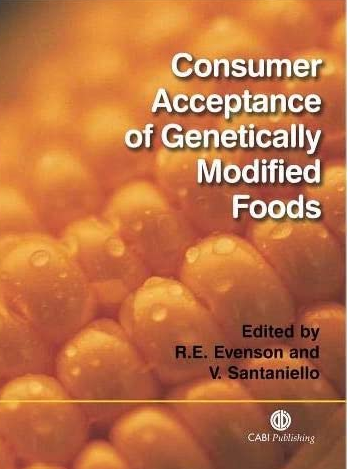
Description
Consumer Acceptance of Genetically Modified Foods by Robert E. Evenson, ISBN-13: 978-0851997476
[PDF eBook eTextbook]
- Publisher: CABI; First edition (April 21, 2004)
- Language: English
- 288 pages
- ISBN-10: 0851997473
- ISBN-13: 978-0851997476
After almost 20 years in the laboratory and the experimental fields, agrobiotechnology arrived at the market in the mid-1990s and was quickly embraced by farmers in key agricultural producing countries. In 1996, less than 4 million acres in six countries were planted with bioengineered crops. By 2001, worldwide adoption expanded to more than 115 million acres (James, 2002). For some countries, including the USA, uptake of bioengineered crops has been so fast that prior adoption of even dominant agricultural technologies (e.g. hybrid maize) pale in comparison (Kalaitzandonakes, 2003).
Some consumers in Europe and in other parts of the world, however, have been sceptical and often combative towards the new technology (Gaskel et al.). Nothing has underscored the public acceptance woes of agrobiotechnology more strongly than the widespread bans imposed by food companies on genetically modified (GM) food ingredients in Europe and elsewhere. GM food bans began in Europe on 1 May 1998 when Iceland – a small UK food retail chain – announced that it had removed all GM ingredients from its private label products. Within a few months, similar announcements by large food retailers and food manufacturers poured in.
The most significant early announcement came from a consortium of seven major European food retailers on 17 March 1999. Led by UK-based Sainsbury’s, the consortium had formed to source non-GM ingredients for its members’ private label products. With over $100 billion in combined sales, 40% in private labels, the consortium’s announcement set the tone for a cascade of similar actions in the European food industry. By autumn of 1999, some key European food retailers and manufacturers had announced their intent to remove GM ingredients from their branded products.
Outside Europe, bans of GM food ingredients by major food companies were more sporadic. Starting in the autumn of 1999, a small number of large food manufacturers and retailers in Japan, Taiwan, the USA and other parts of the world announced intent to remove GM ingredients from their branded products.
Bans against GM food ingredients by major food companies have been broadly reported and have been often taken to signal demand shifts away from bioengineered commodities in favour of identity-preserved non-GM crops. Yet, the impacts of such bans have not been quantified and, indeed, the market size for non-GM crops remains unknown. In this study we assess the significance of bans imposed by major food companies against bioengineered commodities by investigating the response of commodity prices to such bans.
Assuming agricultural commodity futures markets are efficient, new information suggesting a possible demand shift should affect these markets. Thus, movements in agricultural commodity futures prices in response to reports on voluntary bans against bioengineered commodities by major food companies can provide an indirect account of the expected impacts of such announcements. Within this context, we empirically examine whether soybean futures market prices react to news about voluntary bans against bioengineered commodities by food firms. The Chicago Board of Trade (CBOT) soybean futures contract specification is for #2 yellow soybean of US origin of specific quality characteristics, e.g. test weight, damaged kernel. The CBOT soybean futures market represents the primary price discovery mechanism for soybeans in the USA. Ban announcements should produce sustained impacts on futures prices only if a shift in the demand for non-GMO soybean is sufficient to negatively influence the market for commodity- grade soybean.
We also investigate the impacts of GM ban announcements on the returns of non-GM soybean futures. The offering of the Tokyo Grain Exchange (TGE) non-GMO soybean futures contract allows analysis on such impacts. If the ban announcements signal significant demand shifts, then the TGE non- GMO soybean futures price should respond positively to the news.
This study builds on this rich event study literature and examines how soybean futures prices respond to announcements of bans against GM ingredients by major food firms. It also extends the previous literature in two ways. First, it investigates not only the immediate and separate impact of ban announcements but also their potential cumulative effects. Specifically, the hypothesis that each additional announcement might have a greater impact on markets than prior ones by signalling a progressively shifting market is explicitly tested. Second, this study examines the response of separate but interdependent market segments to such ban announcements – a major commodity market that can be diminished and a smaller specialized non-GM market that can be enhanced.
What makes us different?
• Instant Download
• Always Competitive Pricing
• 100% Privacy
• FREE Sample Available
• 24-7 LIVE Customer Support
Reviews
There are no reviews yet.