 Elementary Statistics Using Excel (6th Edition) – eBook
  Feedback Control of Dynamic Systems (8th Edition) -eBook
  James Stewart’s Calculus: Early Transcendentals (8th edition) – eTextBook
  Writing Case Reports: A Practical Guide from Conception through Publication, ISBN-13: 978-3319419008
  The Joy of Abstraction: An Exploration of Math, Category Theory, and Life by Eugenia Cheng, ISBN-13: 978-1108477222
  Workbook for Diagnostic Medical Sonography: The Vascular System 2nd Edition, ISBN-13: 978-1496385635
  The Economic Way of Thinking 13th Edition Paul Heyne, ISBN-13: 978-0132991292
  Modern Physics 4th Edition by Kenneth S. Krane, ISBN-13: 978-1119495550
  You’re Wrong, I’m Right: Dueling Authors Reexamine Classic Teachings in Anesthesia, ISBN-13: 978-3319431673
  The 100 Most Important Chemical Compounds Richard L. Myers, ISBN-13: 978-0313337581
  Structural Analysis and Design of Process Equipment 3rd Edition, ISBN-13: 978-1119102830
  Quanta, Matter and Change: A Molecular Approach to Physical Chemistry, ISBN-13: 978-0716761174
  Leadership: Theory and Practice (7th Edition) – eBook
  Wintrobe’s Atlas of Clinical Hematology 2nd Edition Babette Weksler, ISBN-13: 978-1605476148
  AACN Essentials of Progressive Care Nursing 3rd Edition, ISBN-13: 9780071822923
  Abnormal Psychology: A Scientist-Practitioner Approach 4th Edition Deborah C. Beidel, ISBN-13: 978-0134238883
  Abnormal Psychology 16th Edition James N. Butcher, ISBN-13: 978-0205944286
  Abnormal Psychology: Perspectives 6th Edition David Dozois, ISBN-13: 978-0134428871
  A Compendium of Neuropsychological Tests 3rd Edition, ISBN-13: 978-0195159578
  Project Management: The Managerial Process (7th Edition) – eBook
  Psychology in Action (12th Edition) – eBook
  A Visual Analogy Guide to Human Anatomy & Physiology Paul A. Krieger, 1st Edition, ISBN-13: 978-0895828019
  Nutrition: An Applied Approach (5th Edition) – eBook
  AACN Essentials of Critical Care Nursing 3rd Edition, ISBN-13: 9780071822794
  The Art of Memory Forensics: Detecting Malware and Threats in Windows, Linux, and Mac Memory – PDF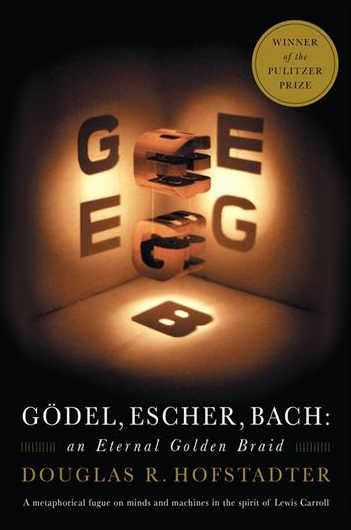
Description
Gödel, Escher, Bach: An Eternal Golden Braid by Douglas R. Hofstadter, ISBN-13: 978-0465026562
[PDF eBook eTextbook]
- Publisher: Basic Books; 20th Anniversary ed. edition (February 5, 1999)
- Language: English
- 824 pages
- ISBN-10: 0465026567
- ISBN-13: 978-0465026562
A metaphorical fugue on minds and machines in the spirit of Lewis Carroll.
Douglas Hofstadter’s book is concerned directly with the nature of “maps” or links between formal systems. However, according to Hofstadter, the formal system that underlies all mental activity transcends the system that supports it. If life can grow out of the formal chemical substrate of the cell, if consciousness can emerge out of a formal system of firing neurons, then so too will computers attain human intelligence. Gödel, Escher, Bach is a wonderful exploration of fascinating ideas at the heart of cognitive science: meaning, reduction, recursion, and much more.
Twenty years after it topped the bestseller charts, Douglas R. Hofstadter’s Gödel, Escher, Bach: An Eternal Golden Braid is still something of a marvel. Besides being a profound and entertaining meditation on human thought and creativity, this book looks at the surprising points of contact between the music of Bach, the artwork of Escher, and the mathematics of Gödel. It also looks at the prospects for computers and artificial intelligence (AI) for mimicking human thought. For the general reader and the computer techie alike, this book still sets a standard for thinking about the future of computers and their relation to the way we think.
Hofstadter’s great achievement in Gödel, Escher, Bach was making abstruse mathematical topics (like undecidability, recursion, and ‘strange loops’) accessible and remarkably entertaining. Borrowing a page from Lewis Carroll (who might well have been a fan of this book), each chapter presents dialogue between the Tortoise and Achilles, as well as other characters who dramatize concepts discussed later in more detail. Allusions to Bach’s music (centering on his Musical Offering) and Escher’s continually paradoxical artwork are plentiful here. This more approachable material lets the author delve into serious number theory (concentrating on the ramifications of Gödel’s Theorem of Incompleteness) while stopping along the way to ponder the work of a host of other mathematicians, artists, and thinkers.
The world has moved on since 1979, of course. The book predicted that computers probably won’t ever beat humans in chess, though Deep Blue beat Garry Kasparov in 1997. And the vinyl record, which serves for some of Hofstadter’s best analogies, is now left to collectors. Sections on recursion and the graphs of certain functions from physics look tantalizing, like the fractals of recent chaos theory. And AI has moved on, of course, with mixed results. Yet Gödel, Escher, Bach remains a remarkable achievement. Its intellectual range and ability to let us visualize difficult mathematical concepts help make it one of this century’s best for anyone who’s interested in computers and their potential for real intelligence. –Richard Dragan
Topics Covered: J.S. Bach, M.C. Escher, Kurt Gödel: biographical information and work, artificial intelligence (AI) history and theories, strange loops and tangled hierarchies, formal and informal systems, number theory, form in mathematics, figure and ground, consistency, completeness, Euclidean and non-Euclidean geometry, recursive structures, theories of meaning, propositional calculus, typographical number theory, Zen and mathematics, levels of description and computers; theory of mind: neurons, minds and thoughts; undecidability; self-reference and self-representation; Turing test for machine intelligence.
Douglas R. Hofstadter is College of Arts and Sciences Professor of Cognitive Science and Computer Science at Indiana University, Bloomington, where he also directs the Center for Research on Concepts and Cognition. He is the author or co-author of nine books, including I Am a Strange Loop and Surfaces and Essences, and has contributed to ten more. He lives in Bloomington.
What makes us different?
• Instant Download
• Always Competitive Pricing
• 100% Privacy
• FREE Sample Available
• 24-7 LIVE Customer Support


Reviews
There are no reviews yet.