 Interplay: The Process of Interpersonal Communication (14th Edition) – eBook PDF
  Pharmacotherapeutics for Advanced Practice Nurse Prescribers (4th Edition)
  Elementary Statistics Using Excel (6th Edition) – eBook
  Starting Out with Python 4th GLOBAL Edition, ISBN-13: 978-1292225753
  Leadership: Theory and Practice (7th Edition) – eBook
  Project Management: The Managerial Process (7th Edition) – eBook
  A How To Guide For Medical Students Michael J. Englesbe, ISBN-13: 978-3319428956
  You’re Wrong, I’m Right: Dueling Authors Reexamine Classic Teachings in Anesthesia, ISBN-13: 978-3319431673
  Myers’ Psychology (12th Edition) – eBook
  T-SQL Fundamentals 3rd Edition by Itzik Ben-Gan, ISBN-13: 978-1509302000
  Oxford Handbook of Clinical Immunology and Allergy 3rd Edition, ISBN-13: 978-0199603244
  James Stewart’s Calculus: Early Transcendentals (8th edition) – eTextBook
  SPSS Demystified 3rd Edition by Ronald Yockey, ISBN-13: 978-1138286283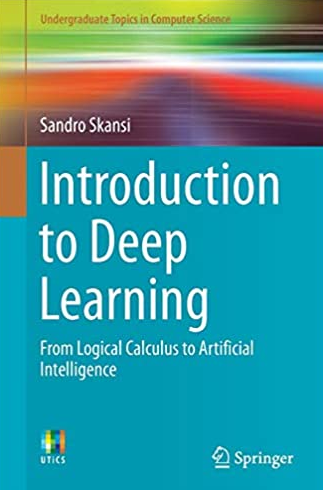
Description
Introduction to Deep Learning: From Logical Calculus to Artificial Intelligence, ISBN-13: 978-3319730035
[PDF eBook eTextbook]
- Publisher: Springer; 1st ed. 2018 edition (February 15, 2018)
- Language: English
- 204 pages
- ISBN-10: 3319730037
- ISBN-13: 978-3319730035
This textbook presents a concise, accessible and engaging first introduction to deep learning, offering a wide range of connectionist models which represent the current state-of-the-art. The text explores the most popular algorithms and architectures in a simple and intuitive style, explaining the mathematical derivations in a step-by-step manner. The content coverage includes convolutional networks, LSTMs, Word2vec, RBMs, DBNs, neural Turing machines, memory networks and autoencoders. Numerous examples in working Python code are provided throughout the book, and the code is also supplied separately at an accompanying website.
Topics and features: introduces the fundamentals of machine learning, and the mathematical and computational prerequisites for deep learning; discusses feed-forward neural networks, and explores the modifications to these which can be applied to any neural network; examines convolutional neural networks, and the recurrent connections to a feed-forward neural network; describes the notion of distributed representations, the concept of the autoencoder, and the ideas behind language processing with deep learning; presents a brief history of artificial intelligence and neural networks, and reviews interesting open research problems in deep learning and connectionism.This clearly written and lively primer on deep learning is essential reading for graduate and advanced undergraduate students of computer science, cognitive science and mathematics, as well as fields such as linguistics, logic, philosophy, and psychology.
Topics and features:
- Introduces the fundamentals of machine learning, and the mathematical and computational prerequisites for deep learning
- Discusses feed-forward neural networks, and explores the modifications to these which can be applied to any neural network
- Examines convolutional neural networks, and the recurrent connections to a feed-forward neural network
- Describes the notion of distributed representations, the concept of the autoencoder, and the ideas behind language processing with deep learning
- Presents a brief history of artificial intelligence and neural networks, and reviews interesting open research problems in deep learning and connectionism
This clearly written and lively primer on deep learning is essential reading for graduate and advanced undergraduate students of computer science, cognitive science and mathematics, as well as fields such as linguistics, logic, philosophy, and psychology.
Dr. Sandro Skansi is an Assistant Professor of Logic at the University of Zagreb and Lecturer in Data Science at University College Algebra, Zagreb, Croatia.
What makes us different?
• Instant Download
• Always Competitive Pricing
• 100% Privacy
• FREE Sample Available
• 24-7 LIVE Customer Support

Reviews
There are no reviews yet.