 AACN Essentials of Critical Care Nursing 3rd Edition, ISBN-13: 9780071822794
  Managerial Accounting (16th Edition) – eBook
  101 Trauma-Informed Interventions Linda Curran, ISBN-13: 978-1936128426
  American Higher Education, Leadership, and Policy: Critical Issues and the Public Good, ISBN-13: 978-0230615090
  Fundamentals of Information Systems Security (3rd Edition) – eBook
  Understanding Business (12th edition) – PDF – eTextBook
  3D Automated Breast Volume Sonography: A Practical Guide, ISBN-13: 978-3319419701
 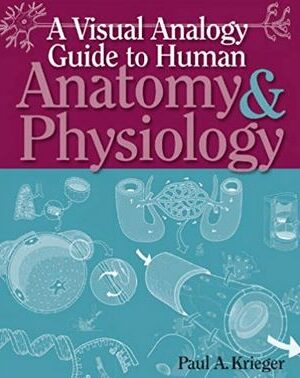 A Visual Analogy Guide to Human Anatomy & Physiology Paul A. Krieger, 1st Edition, ISBN-13: 978-0895828019
  Abnormal Psychology 9th Edition Thomas Oltmanns, ISBN-13: 978-0134899053
  Abnormal Psychology: A Scientist-Practitioner Approach 4th Edition Deborah C. Beidel, ISBN-13: 978-0134238883
  Working Through Conflict 9th Edition Joseph P. Folger, ISBN-13: 978-0367461478
  AACN Essentials of Progressive Care Nursing 3rd Edition, ISBN-13: 9780071822923
  Vector Calculus, Linear Algebra, and Differential Forms 5th Edition, ISBN-13: 978-0971576681
  Interplay: The Process of Interpersonal Communication (14th Edition) – eBook PDF
  A How To Guide For Medical Students Michael J. Englesbe, ISBN-13: 978-3319428956
  Thinking in Systems: A Primer Donella H. Meadows, ISBN-13: 978-1603580557
  Basic and Clinical Pharmacology 14th Edition, ISBN-13: 978-1259641152
  Normal and Abnormal Fetal Face Atlas: Ultrasonographic Features, ISBN-13: 978-3319437682
  Brock Biology of Microorganisms 15th edition (global) – eTextBook
  Wintrobe’s Atlas of Clinical Hematology 2nd Edition Babette Weksler, ISBN-13: 978-1605476148
  Nutrition: An Applied Approach (5th Edition) – eBook
  Farmacologia Basica e Clinica (13ª edição) – eBook PDF
  COMPACT Literature: Reading, Reacting, Writing (9th Edition) 2016 MLA Update eTextbook
  Using Econometrics: A Practical Guide 7th Edition, ISBN-13: 978-0134182742
  The Practice of Professional Consulting 1st Edition, ISBN-13: 978-1118241844
 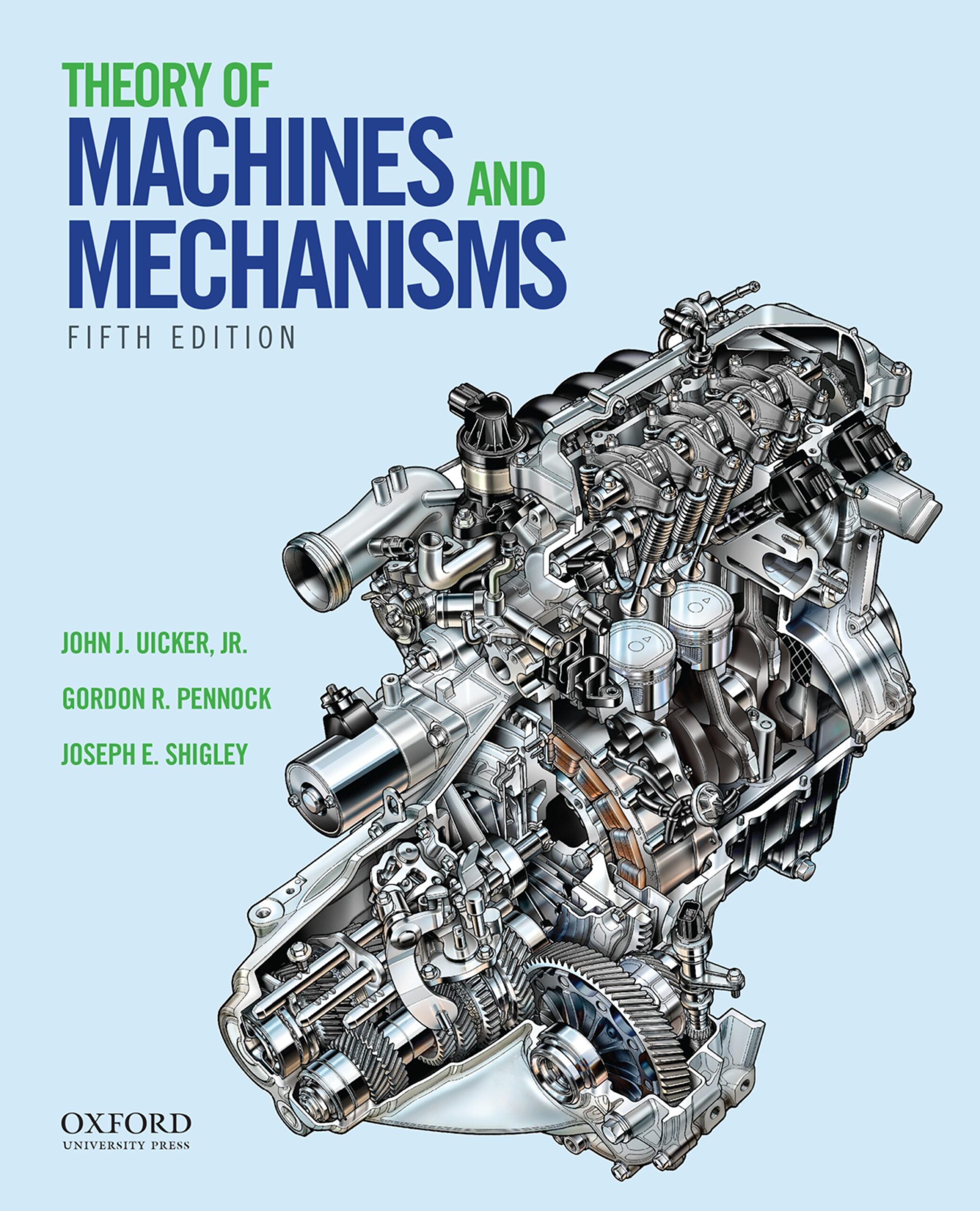 Theory of Machines and Mechanisms (5th Edition) – eBook PDF
  The Equation of Knowledge: From Bayes’ Rule to a Unified Philosophy of Science, ISBN-13: 978-0367428150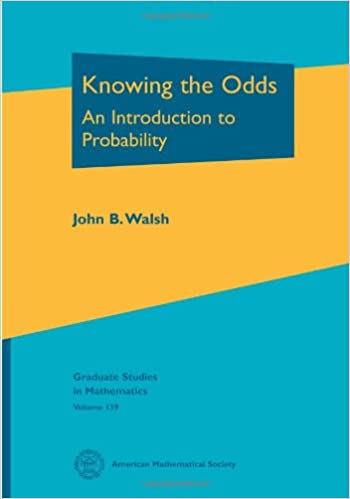
Description
Knowing the Odds: An Introduction to Probability by John B. Walsh, ISBN-13: 978-0821885321
[PDF eBook eTextbook]
- Publisher: American Mathematical Society (September 6, 2012)
- Language: English
- 421 pages
- ISBN-10: 0821885324
- ISBN-13: 978-0821885321
This book covers in a leisurely manner all the standard material that one would want in a full year probability course with a slant towards applications in financial analysis at the graduate or senior undergraduate honors level. It contains a fair amount of measure theory and real analysis built in but it introduces sigma-fields, measure theory, and expectation in an especially elementary and intuitive way. A large variety of examples and exercises in each chapter enrich the presentation in the text.
There is an order to chaos. Unpredictability is predictable. In fact, randomness itself is so regular that we can assign a number to a random occurrence which tells us in a precise way how likely it is. The number is called its probability. That is not to say that we can predict the result of a single toss of a fair coin. We cannot. But we can predict that between forty and sixty out of a hundred tosses will be heads. We might—rarely—be wrong about that, but only once or twice in a hundred tries, and if we continue to toss: a thousand times, a million times, and so on, we can be sure that the proportion of heads will approach 1/2. So randomness has its own patterns. Our aim is to understand them. Probability is a rather unusual part of mathematics. While its full birth as a mathematical subject can be traced to the correspondence between Fermat and Pascal1 in the summer of 1654, the subject wasn’t put on a rigorous footing until 1934, 270 years later, when A. N. Kolmogorov showed it was properly a part of measure theory. But probability had been around for several centuries before measure theory existed, and it is quite possible to study the subject without it. In fact, probability is taught at many different levels, according to the mathematics the students know: in elementary and high school, first year college, third or fourth year college, as well as in graduate school. Certain things are common to all of these courses, but the the more mathematics the student knows, the deeper he or she can go. This particular text is drawn from a two-semester course taught over the years at the University of British Columbia, mainly to fourth-year mathematics honors students. It assumes the student is familiar with calculus and knows some analysis, but not measure theory. Many of the students, but by no means all, take a concurrent course in Lebesgue measure. It is not necessary, but it adds depth, and gives the student some “Aha!” moments, such as the sudden realization: “Aha! The expectation is nothing but a Lebesgue integral!”
John Walsh, one of the great masters of the subject, has written a superb book on probability. It covers at a leisurely pace all the important topics that students need to know, and provides excellent examples. I regret his book was not available when I taught such a course myself, a few years ago. —-Ioannis Karatzas, Columbia University
In this wonderful book, John Walsh presents a panoramic view of Probability Theory, starting from basic facts on mean, median and mode, continuing with an excellent account of Markov chains and martingales, and culminating with Brownian motion. Throughout, the author’s personal style is apparent; he manages to combine rigor with an emphasis on the key ideas so the reader never loses sight of the forest by being surrounded by too many trees. As noted in the preface, “To teach a course with pleasure, one should learn at the same time.” Indeed, almost all instructors will learn something new from the book, (e.g. the potential-theoretic proof of Skorokhod embedding) and at the same time, it is attractive and approachable for students. —-Yuval Peres, Microsoft
With many examples in each section that enhance the presentation, this book is a welcome addition to the collection of books that serve the needs of advanced undergraduate as well as first year graduate students. The pace is leisurely which makes it more attractive as a text. —-Srinivasa Varadhan, Courant Institute, New York
What makes us different?
• Instant Download
• Always Competitive Pricing
• 100% Privacy
• FREE Sample Available
• 24-7 LIVE Customer Support
Reviews
There are no reviews yet.